
The William Shakespeare 2 pound coin crown and sword value question looks simple at first. In practice, it depends on the role this coin plays in a modern UK collection. The Shakespeare Histories £2 is not a major rarity. It is also not an empty face-value piece with no collector interest. It sits in the middle: accessible, widely known, and still worth choosing carefully.
What the Сoin Is
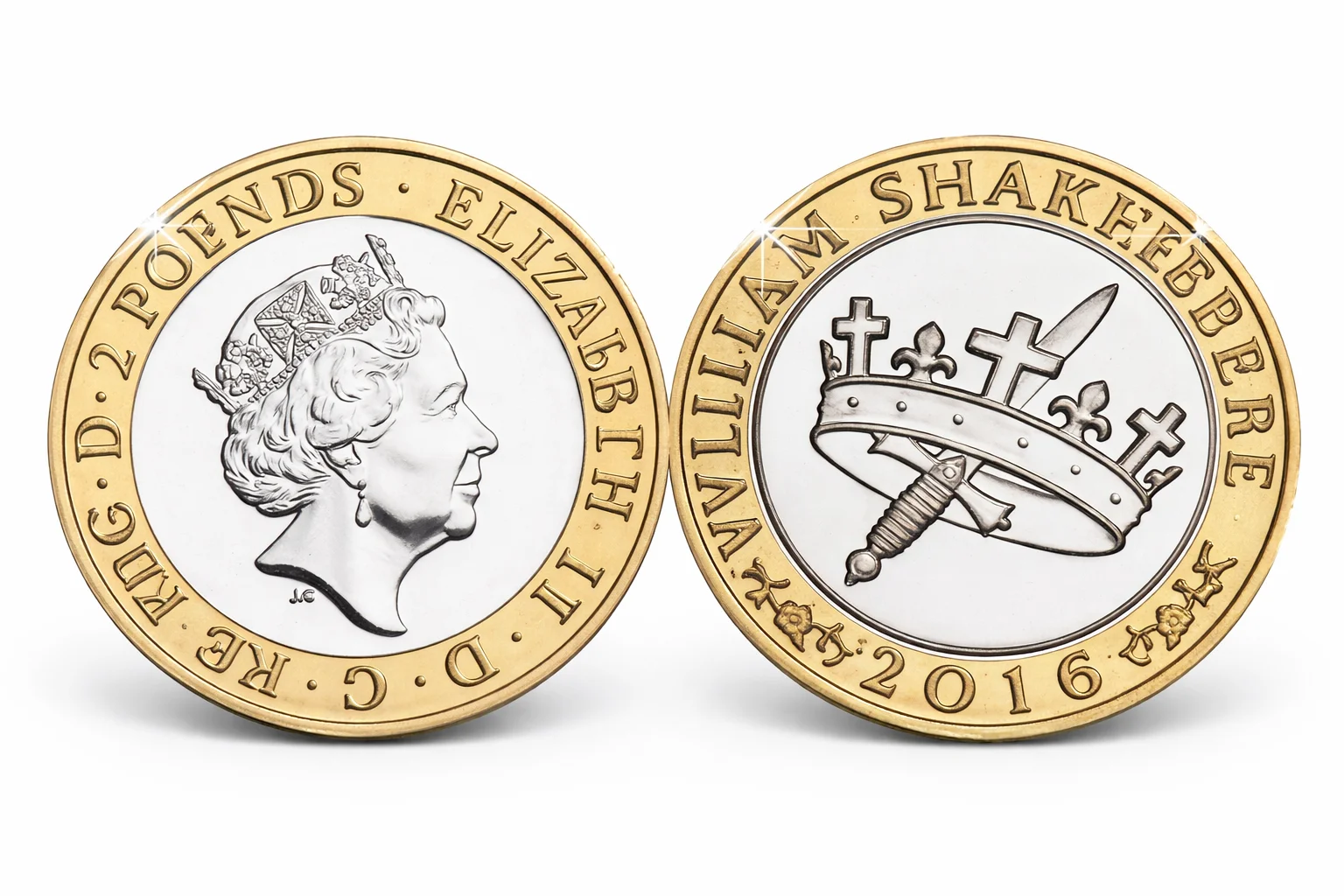
The Shakespeare Histories £2 was issued in 2016 to mark the 400th anniversary of Shakespeare’s death. It is one of three related £2 designs from that year. The reverse shows a crown pierced by a blade, with the inscription “WILLIAM SHAKESPEARE” and the date below. The edge reads “THE HOLLOW CROWN.” The reverse was designed by John Bergdahl, and the obverse uses Jody Clark’s fifth portrait of Queen Elizabeth II.
This is a circulating commemorative £2. It is not a silver circulation issue and not a bullion coin. The standard piece is a bimetallic coin with a copper-nickel centre, nickel-brass ring, 12.0 g weight, and 28.4 mm diameter. Those details matter because many inflated listings try to make an ordinary circulation coin sound much scarcer or more special than it is.
If mintage is part of the discussion, the working figure to use is 5,655,000 coins struck for circulation. That places the coin in the available modern-collectable category, not in the true scarcity category.
Why Collectors Still Keep It
This coin works well in several kinds of collections.
As part of the Shakespeare trio
- Histories
- Comedies
- Tragedies
Many collectors do not want just one coin. They want the full 2016 Shakespeare group. That gives the Histories coin a stable place in set building.
As part of a circulating £2 run
- It is easy to understand
- It belongs to a known commemorative series
- It is still found and traded without much difficulty
That makes it practical for collectors who build modern UK type sets or date runs from circulation pieces.
As a thematic coin
- Literature
- Theatre
- British cultural history
- Symbolic designs on circulating coinage
This matters more than many price guides show. Some modern coins survive because of mintage alone. Others survive because the design keeps attention on them. The Shakespeare Histories £2 benefits from the second factor.
Where It Stands in the Market
The real market for this coin is modest. A normal circulated piece is usually a low-premium coin. A cleaner coin can do a little better. A true BU example in original collector format sits in a higher bracket, but still not in a dramatic one. Coin Hunter lists the circulation coin at face value and places a BU piece at about £8 in as-new condition.
Numista’s user-and-sales-based indications place circulated examples around the low single-digit dollar level and an uncirculated piece around $8.10, with BU around $14 as an indicative figure. These are not fixed prices, but they show the market clearly: this is not a jackpot coin in ordinary form.
Approximate market ranges
| Format/state | Practical market range |
| Worn circulated | about £2 |
| Better circulated | about £2–£4 |
| Uncirculated circulation strike | about £4–£7 |
| BU / collector-pack example | about £8–£12 |
These ranges are broad on purpose. They reflect the gap between raw market reality and optimistic listings. Prices shift with eye appeal, packaging, and how the coin is offered. The main point stays the same: the premium is real, but usually moderate.
What Actually Moves The Price
The year and design bring attention. Condition does the real work.
1. Surface quality
Circulated £2 coins pick up marks quickly. The Shakespeare Histories coin is no exception. Contact marks on the portrait side, dull fields, and rim knocks reduce appeal fast. On a coin of this type, the market does not reward a tired example much above its denomination. Coin Hunter also notes that better circulated coins remain more desirable when they keep more original shine and design detail.
2. Eye appeal
Two coins can have the same date and the same basic grade range, but sell differently in practice. One looks clean and balanced. The other looks busy, grey, and hit up. Modern UK commemoratives are very sensitive to that difference. A coin that looks fresh is easier to place in a collection.
3. Strike and design clarity
This is not a variety-driven issue in the usual sense. Still, sharper detail helps. Clear lettering, a stronger central design, and a cleaner edge all make the coin easier to sell. Weak-looking pieces do not attract the same interest.
4. Format
A raw coin from circulation and a packaged BU coin belong to different parts of the market. The design may be the same, but the buyer is not always the same. One buyer wants a type coin for an album. Another wants a neat collector example that has not spent years in change. Coin Hunter separates these markets clearly by listing circulation and BU values differently.
Rare, Scarce, or Just Popular?
This is where many articles become vague. The better answer is simple.
The Shakespeare Histories £2 is not rare in a strict numismatic sense. A circulation mintage of 5,655,000 is too high for that. At the same time, the coin is not ignored. It remains popular because it belongs to a recognisable three-coin Shakespeare group, has a strong literary theme, and fits well in modern UK collections.
That mix matters. A coin can be widely available and still worth keeping. In modern British collecting, many pieces survive in large numbers. The ones that stay relevant usually do so because collectors keep returning to them for sets, themes, and design interest. This coin does exactly that.
Practical Buying Advice
If the goal is to add one good example to a collection, keep the process simple.
Check these points first:
- Fields for heavy marks
- Centre and ring for knocks
- Edge lettering for completeness
- General lustre
- Whether the coin is a raw circulation, uncirculated circulation strike, or BU product
Do not pay a strong premium for a coin that is just average. Modern £2 pieces are common enough that patience usually works in your favour.
A second point is format control. Some buyers think every clean Shakespeare Histories coin is a BU coin. That is not correct. A coin can look fresh and still be a circulation strike that was just stored well. If you do not want to spend time comparing every packaging type by hand, Coin ID Scanner can help at the first-pass stage.
Its Smart Filters and AI assistant make it easier to narrow the coin to the right issue and avoid slow manual searching through similar £2 commemoratives, and a coin identifier is useful here when sorting mixed modern material. The final buying decision, though, should still come from direct inspection.
Myths and Bad Market Claims
Modern British coins attract hype. This issue gets its share of it.
The most common problem is the “rare error” claim on ordinary coins. Coin Hunter states that no mint errors for the Shakespeare Histories £2 have been confirmed by The Royal Mint. That alone should make buyers cautious.
Another repeated claim concerns upside-down edge lettering. Royal Mint guidance is clear: there is no correct or incorrect way for the edge inscription to line up with the obverse or reverse. The lettering is applied before striking, so the final orientation can appear either way. That means upside-down edge text is not automatically an error and does not create a premium by itself.
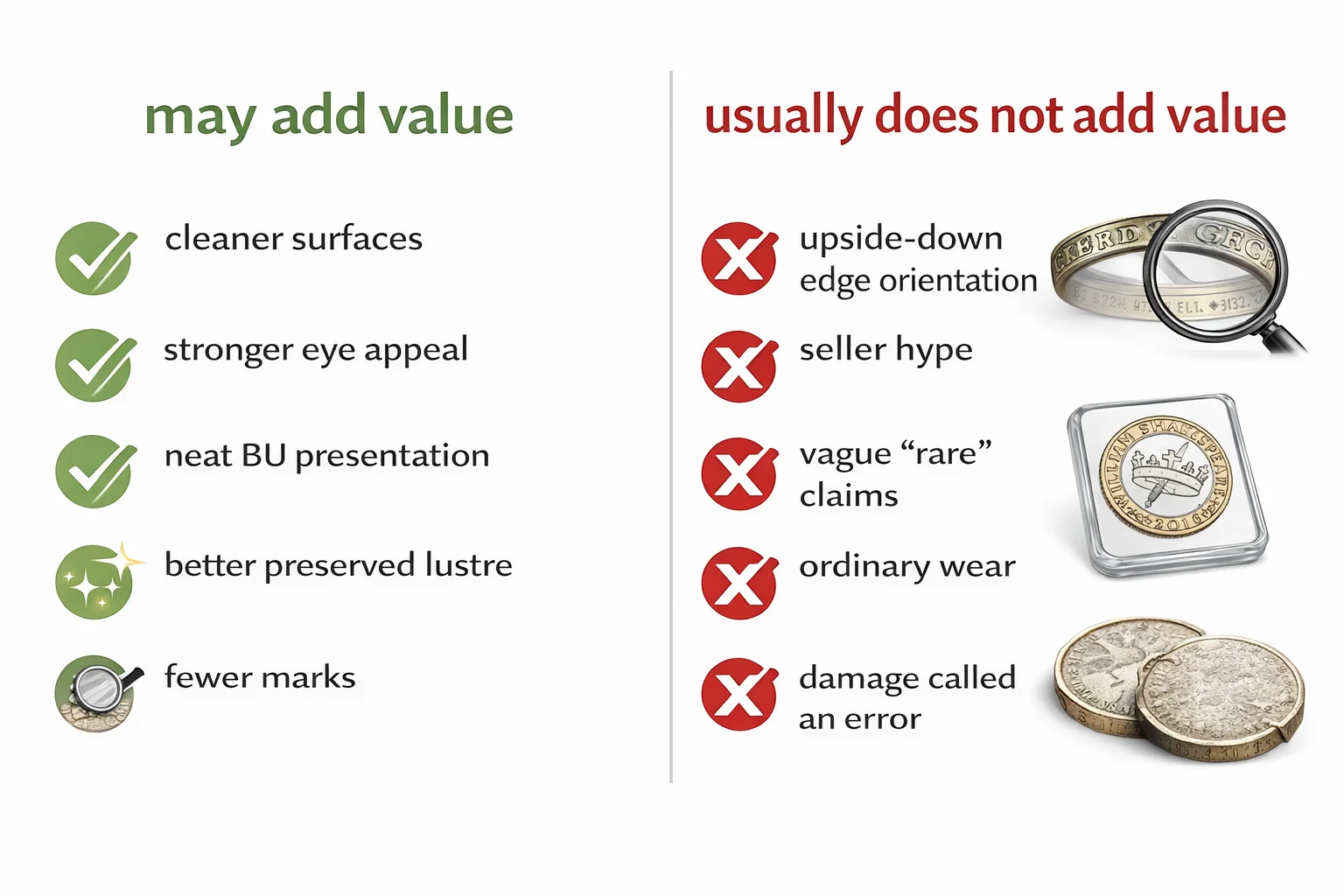
What adds value and what does not
| May add value | Usually does not add value |
| cleaner surfaces | ordinary circulation wear |
| stronger eye appeal | seller hype |
| neat BU presentation | upside-down edge orientation |
| fewer marks | vague “rare” claims |
| better preserved lustre | damage called an error |
This is the practical rule: buy the coin, not the headline.
How it Compares With Other Modern £2 Coins
Within the wider UK £2 series, the Shakespeare Histories coin sits in a useful middle position. It is more interesting than a purely routine modern commemorative with weaker thematic support. It is less difficult than truly scarce modern £2 pieces. That is one reason it remains a reasonable target for collectors who want a balanced set without chasing only top-end issues.
It also helps that the design is easy to recognise. Some modern coins need a long explanation. This one does not. Crown, blade, Shakespeare, 2016. The message is direct. The market tends to reward that kind of clarity with steady interest, even when the coin is not scarce.
Should You Keep One?
For many collectors, yes.
- If you build a modern UK £2 collection, it fits well.
- If you collect literature or theatre themes, it fits even better.
- If you focus only on strict rarity, it is less important.
- If you are new to British commemoratives, it is a practical entry coin.
Newer buyers sometimes compare dealer stock, recently sold levels, and free coin apps before making a decision. That can help with orientation. It should not replace a simple check of condition, format, and real market level. This coin rewards sensible buying more than speed.
Final view
The Shakespeare Histories £2 is not a hidden rarity. It is not a throwaway coin either. It has a clear place in a modern UK collection because it combines a strong theme, a recognisable design, and steady demand from set builders and thematic collectors.
Its value is usually moderate. Condition drives the premium. Packaging can help. Hype should be ignored. That is the cleanest way to read the coin today.
If the goal is one piece for a British £2 set, a clean example makes sense. If the goal is a top-end rarity, look elsewhere. That is why the coin remains useful: it is easy to understand, easy to place, and still worth choosing with care.